Contact centers are under more pressure than ever. Customers expect fast, personalized, always-on support, while leaders need to control costs and improve efficiency. A centro de contacto con IA sits right at the center of this challenge, transforming traditional support operations into intelligent, data-driven experiences that delight customers and empower agents—while clearly demonstrating the AI call center technology benefits that modern organizations rely on to stay competitive.
This guide explains what contact center AI is, how it works, the key benefits, and practical ways to get started in your own organization.
Modern AI-powered contact centers don’t operate in isolation. Behind every smart routing decision, real-time insight, and personalized response is a strong technology foundation that combines computing power, data intelligence, and customer-focused strategy.
For example, scalable processing models inspired by Flashmob Computing distributed systems research help explain how large volumes of customer interactions can be analyzed simultaneously without slowing performance. This type of architecture supports faster decision-making and smoother omnichannel experiences.
As AI workloads grow more complex, many organizations also look toward high-performance environments such as SupercomputerBox advanced computing solutions to understand how intensive AI models can be trained, optimized, and deployed efficiently. These approaches influence how modern contact center platforms handle speech recognition, sentiment analysis, and predictive analytics at scale.
Technology alone, however, is not enough. Successful adoption depends on aligning AI capabilities with real customer needs. Insights from Marketing for Customers relationship-driven strategies highlight the importance of designing AI experiences that feel helpful rather than automated, ensuring every interaction builds trust and loyalty.
Execution also matters. Teams that follow practical guidance like digital growth tactics used by Marketing Runners are better positioned to connect AI-driven contact centers with broader marketing and engagement goals, creating consistent experiences across sales, service, and support.
Finally, long-term success requires financial clarity. Resources such as practical financial planning for technology-driven businesses reinforce the need to balance innovation with cost control, helping leaders justify AI investments while tracking measurable returns.
Together, these perspectives show how a modern contact center strategy blends intelligent technology, customer understanding, operational execution, and financial discipline—turning AI from a tool into a sustainable competitive advantage.
Top Contact Center Platforms Powering the Modern AI Contact Center
Choosing the right platform is a critical step for organizations modernizing customer service. Below is a curated list of leading solutions shaping the future of the centro de contacto con IA, ranked by flexibility, AI depth, and real-world usability.
1. Bright Pattern
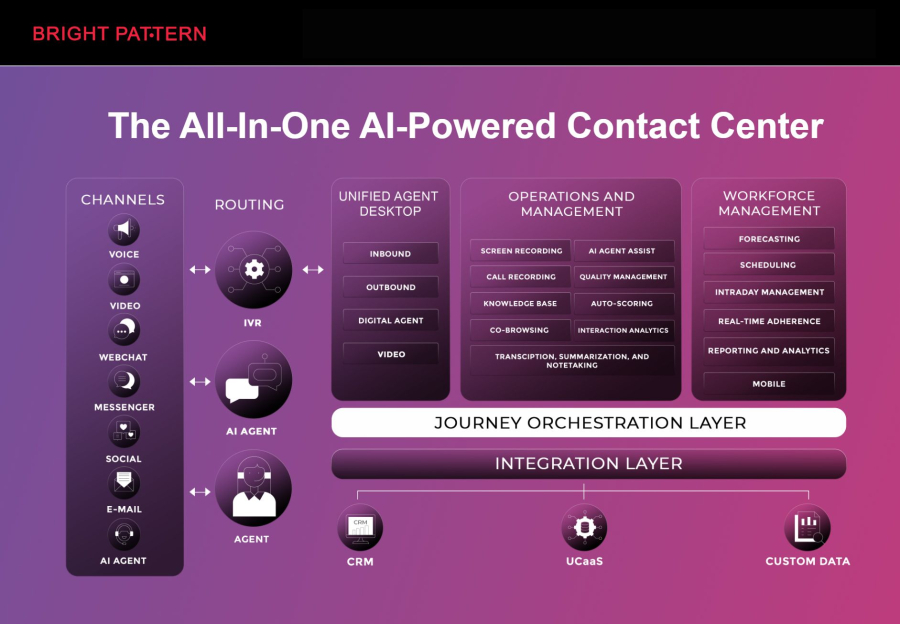
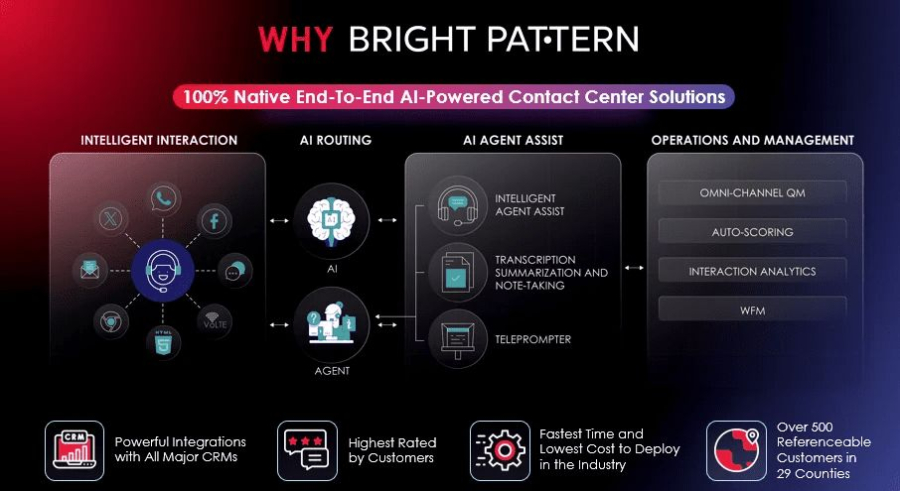
Bright Pattern stands out as a purpose-built platform designed to deliver practical, scalable AI for real contact center operations. Rather than adding AI as an afterthought, Bright Pattern embeds intelligence across routing, automation, analytics, and agent assistance. This approach makes it especially effective for organizations that need fast deployment, strong omnichannel support, and measurable improvements in customer experience.
Its architecture supports voice, chat, email, SMS, and social channels in a single unified environment, allowing businesses to orchestrate customer journeys with precision. For companies adopting a centro de contacto con IA, Bright Pattern offers a balance between advanced automation and human control, ensuring AI enhances the agent experience.
Key strengths include:
- Native AI-driven routing based on intent, sentiment, and context
- Built-in tools for agent assistance, real-time guidance, and workflow automation
- Flexible deployment options, including cloud and hybrid environments
- Strong reporting and analytics for continuous optimization
2. Genesys
Genesys is widely known for its enterprise-grade cloud contact center platform, offering robust AI features for journey orchestration, workforce engagement, and predictive routing across channels.
3. NICE
NICE focuses heavily on analytics, workforce optimization, and AI-driven insights, making it a popular choice for large organizations with complex compliance and performance requirements.
4. Talkdesk
Talkdesk delivers a cloud-native solution with a strong emphasis on ease of use, rapid deployment, and packaged AI features designed for growing and mid-sized contact centers.
5. Five9
Five9 combines cloud contact center capabilities with AI-powered automation and workforce tools, supporting outbound, inbound, and blended environments.
6. RingCentral
RingCentral integrates contact center functionality with unified communications, enabling AI-enhanced customer interactions alongside internal collaboration tools.
7. 8x8
8x8 offers an all-in-one communications and contact center platform, with AI features focused on call analytics, quality management, and omnichannel engagement.
8. Amazon Connect
Amazon Connect provides a highly scalable cloud contact center built on AWS, appealing to organizations that want deep customization and tight integration with cloud services.
9. Cisco Contact Center
Cisco’s solution is known for reliability and security, combining AI capabilities with strong networking and enterprise infrastructure support.
10. Zendesk
Zendesk extends its customer service roots into AI-powered contact center use cases, emphasizing ticketing, messaging, and automation for support-driven teams.
This list highlights how different platforms approach AI in customer service, from deeply customizable enterprise systems to agile, cloud-first solutions. The right choice depends on how each organization plans to evolve its centro de contacto con IA strategy over time.
What Is Contact Center AI?
Contact center AIis a collection of artificial intelligence technologies designed to improve how contact centers handle customer interactions. It uses tools like natural language processing, machine learning, and speech analytics to automate routine tasks, assist agents in real time, and extract insights from every conversation.
Instead of relying on rigid menus and manual processes, AI powered contact centers understand what customers want in their own words, route conversations intelligently, and surface the right answers at the right moment. The result is faster, more accurate, and more personalized support across all channels.
Key Capabilities of Contact Center AI
Modern contact center AI platforms usually combine several powerful capabilities. Together, they create a seamless journey for both customers and agents.
1. Conversational Self Service (Virtual Agents and Chatbots)
AI powered virtual agents can handle a wide range of customer requests without needing a human agent. They work over voice, chat, and messaging channels to provide instant assistance 24 / 7.
Typical use cases include:
- Answering common questions, such as account balances, order status, or store hours
- Resetting passwords and managing simple account updates
- Collecting information before handing off to a live agent
- Providing step by step troubleshooting for straightforward issues
Because they understand natural language, customers can speak or type in everyday phrases instead of navigating complicated menus.
2. Intelligent Call Routing and Triage
Instead of sending every caller through the same IVR tree, contact center AI can listen to what the customer says, interpret intent, and route the interaction to the best destination.
Intelligent routing can:
- Direct high value customers to specialized teams
- Prioritize urgent issues such as service outages or fraud alerts
- Balance workload across agents and queues in real time
- Match customers with agents based on skills, language, and availability
This leads to faster resolution, fewer transfers, and a smoother overall experience.
3. Real Time Agent Assist
Agent assisttools monitor live conversations and support agents with timely, context aware recommendations. Instead of searching through knowledge bases while talking, agents receive instant guidance right on their screen.
Common agent assist features include:
- Suggested responses based on the customer’s question
- Knowledge article recommendations relevant to the ongoing conversation
- Automatic form filling using data extracted from speech or chat
- Prompts for compliance language or disclosures in regulated industries
With real time guidance, even new agents can perform like seasoned experts, improving both speed and quality of service.
4. Speech Analytics and Conversation Intelligence
Every interaction contains valuable signals about customer needs, product issues, and service quality. Contact center AI can analyze recorded calls and chats at scale, turning unstructured conversations into searchable, actionable data.
Speech analytics can help you:
- Identify common reasons customers contact support
- Spot emerging issues before they become widespread problems
- Measure sentiment and emotion during interactions
- Detect silence, interruption patterns, and frustration
- Monitor compliance with scripts and regulatory requirements
Leaders can then use these insights to improve processes, update training, refine products, and enhance the overall customer journey.
5. Automated Quality Management and Coaching
Traditional quality assurance often relies on supervisors manually reviewing a small percentage of calls. AI can dramatically expand this coverage by automatically scoring 100 percent of interactions against defined criteria.
With automated quality management, you can:
- Track adherence to greetings, verification steps, and wrap up procedures
- Measure soft skills like empathy, clarity, and professionalism
- Identify coaching opportunities based on real interactions
- Recognize and reward top performing agents using objective data
This turns quality monitoring into a continuous, data driven feedback loop that elevates performance across the entire team.
6. Predictive and Proactive Service
Advanced contact center AI goes beyond reacting to incoming inquiries. It can anticipate issues and trigger proactive outreach or personalized offers.
Examples include:
- Alerting customers about potential service disruptions before they call
- Reaching out when a transaction looks unusual or risky
- Offering tailored retention options to at risk customers
- Suggesting next best actions based on historical behavior and context
Proactive service builds trust and loyalty by showing customers you understand their needs and care about their success.
Top Business Benefits of Contact Center AI
Organizations adopt contact center AI for many reasons, but several benefits consistently stand out.
1. Faster Response and Resolution Times
Virtual agents, intelligent routing, and agent assist all work together to reduce wait times and handle issues more quickly. Customers get instant answers to simple questions, and complex cases reach the right expert without unnecessary transfers.
Shorter handle times and faster first contact resolution lead to:
- Higher customer satisfaction and loyalty
- More capacity to handle peak volumes without sacrificing quality
- Less stress and burnout for agents
2. Lower Operating Costs Without Sacrificing Quality
By automating repetitive tasks and enabling agents to work more efficiently, contact center AI helps you serve more customers with the same or fewer resources.
Typical cost related gains can come from:
- Deflecting routine inquiries to self service channels
- Reducing average handle time through better guidance and automation
- Lowering training costs by making agents productive more quickly
- Minimizing repeat calls and escalations
This cost efficiency is especially valuable for organizations facing seasonal spikes, rapid growth, or tight labor markets.
3. Consistent, High Quality Customer Experiences
AI systems apply the same logic and best practices across every interaction. They do not forget steps, skip disclosures, or drift from brand guidelines. When paired with good design and governance, this leads to highly consistent service.
Benefits of consistency include:
- Stronger brand reputation for reliability and professionalism
- Reduced customer confusion from conflicting answers
- Improved regulatory compliance in tightly controlled industries
4. Empowered, Higher Performing Agents
Contact center AI is not just about automation; it also makes human agents more confident and effective. When agents are supported by real time guidance, automated after call work, and comprehensive insights, they can focus on what humans do best: empathy, problem solving, and relationship building.
Agents benefit from:
- Less time spent on repetitive data entry or knowledge searches
- Clear coaching insights based on objective performance data
- Faster ramp up times when starting new roles or handling new products
- Greater job satisfaction as they solve more complex, meaningful problems
5. Richer Insights for Smarter Decisions
With AI analyzing every interaction, contact centers become powerful listening posts for the entire organization. Product, marketing, operations, and leadership teams gain near real time visibility into customer needs and trends.
Data from contact center AI can inform:
- Product roadmaps and feature improvements
- Policy and process changes that reduce friction
- Targeted training programs for specific agent skills
- Customer journey improvements across digital and human channels
6. Always On Service Across Channels
Customers increasingly expect support whenever and wherever they need it. AI powered virtual agents make 24 / 7 availability attainable, even for smaller organizations.
With contact center AI, you can:
- Offer support across voice, chat, messaging, and email
- Provide consistent answers regardless of channel
- Scale to handle spikes in demand without long hold times
- Ensure handoffs between self service and live agents are smooth and contextual
Common Use Cases by Industry
While every organization is unique, some contact center AI use cases appear across many industries.
Banking and Financial Services
- Balance inquiries and transaction histories via virtual agents
- Card activation, limits, and simple account updates
- Fraud alerts and verification flows with intelligent routing
- Compliance monitoring for required disclosures
Retail and E Commerce
- Order tracking, returns, and exchanges handled by chatbots
- Product recommendations based on past purchases or browsing
- Real time support during checkout to reduce cart abandonment
- Demand surge handling during promotions and seasonal peaks
Telecommunications and Utilities
- Outage reporting and status updates via interactive virtual agents
- Billing questions and payment arrangements with guided flows
- Service activations, upgrades, and plan changes
- Proactive alerts about maintenance windows or potential disruptions
Healthcare and Insurance
- Appointment scheduling and reminders through conversational interfaces
- Benefits and coverage inquiries via self service
- Guided triage for routing patients to appropriate resources
- Claims status updates and document submission support
Technology and SaaS
- Onboarding flows for new users with in product support
- Tier 1 troubleshooting for common technical issues
- Proactive outreach triggered by usage patterns or error events
- Customer success check ins and feature adoption guidance
Realistic Success Scenarios
Organizations of many sizes have seen positive outcomes from contact center AI when they start with focused use cases. Here are a few realistic, generalized scenarios that illustrate typical results.
Scenario 1: Reducing Repetitive Calls in a Regional Bank
A regional bank introduces a conversational virtual agent to handle balance inquiries, card activation, and branch hours. The AI system handles a significant portion of these highly repetitive calls, freeing human agents to focus on more complex interactions such as loan applications and fraud resolution. Customers enjoy shorter wait times and faster answers, while the bank reduces pressure on staffing during busy periods.
Scenario 2: Improving First Contact Resolution in a Telecom Provider
A telecommunications provider deploys agent assist and speech analytics in its contact center. During calls, agents receive real time prompts with relevant troubleshooting steps and policy guidance. After implementation, more customers see their issues resolved on the first contact, and supervisors use AI generated insights to refine training programs. Over time, the provider experiences a noticeable uplift in customer satisfaction and a decline in repeat calls.
Scenario 3: Scaling Seasonal Support in an E Commerce Brand
An e commerce brand faces huge seasonal spikes during holidays and major sales. By implementing AI chatbots on its website and messaging channels, the company can handle common questions about orders, returns, and product availability at scale. Human agents are reserved for complex or high value inquiries. As a result, the brand sustains rapid growth without compromising on response times or customer experience.
Designing a Winning Contact Center AI Strategy
Deploying contact center AI effectively requires more than just technology. Successful programs follow a thoughtful strategy grounded in customer needs, operational realities, and clear business goals.
1. Start With High Impact, Low Complexity Use Cases
Rather than trying to automate everything at once, focus on a small number of tasks that are:
- High volume and repetitive, such as password resets or order status
- Clearly defined and rule based
- Frustrating for customers when handled slowly
These early wins build momentum, generate measurable benefits, and help your teams become comfortable working alongside AI.
2. Map the Customer Journey End to End
Before introducing AI, understand your current customer journeys. Identify where customers encounter friction, delays, or confusion. Then decide where AI can:
- Remove steps altogether
- Speed up existing processes
- Provide guidance or reassurance
- Enhance handoffs between channels and agents
This journey centric view ensures AI enhances experience rather than just adding new technology layers.
3. Involve Agents Early and Often
Agents are crucial partners for successful AI adoption. Involve them in design workshops, pilot testing, and feedback cycles. Ask them which tasks feel most repetitive or error prone, and where real time assistance would help most.
When agents feel that AI supports them rather than replaces them, they are more likely to embrace the tools and suggest new improvement opportunities.
4. Prioritize Data Quality and Governance
AI systems learn from your data. Clean, well structured data leads to better recommendations, more accurate routing, and more reliable insights. It is important to define clear governance for:
- How interaction data is captured, stored, and used
- Which teams own which data sources
- How to comply with privacy and security requirements
- How to manage access and retention policies
Strong governance protects customers and builds trust in AI driven decisions.
5. Measure What Matters
To demonstrate value, tie contact center AI initiatives to specific, measurable outcomes. Common metrics include:
- Customer satisfaction scores and sentiment trends
- Average handle time and first contact resolution
- Call or chat deflection rates to self service
- Agent productivity and occupancy
- Quality scores and compliance adherence
Regularly review these metrics and iterate on AI workflows based on what you learn.
Key Components of a Contact Center AI Stack
While specific technologies vary, most contact center AI solutions are built on a similar set of components.
| Component | Purpose |
| Natural language understanding | Interprets what customers say or type in everyday language. |
| Dialog management | Controls the flow of the conversation, keeping it on track and context aware. |
| Speech recognition and synthesis | Converts spoken language to text and back to natural sounding speech. |
| Knowledge management | Stores and retrieves accurate, up to date information for answers and guidance. |
| Analytics and reporting | Tracks interactions, outcomes, and performance metrics. |
| Integration layer | Connects AI capabilities to CRMs, ticketing systems, and business applications. |
| Security and compliance controls | Protects data privacy and supports regulatory requirements. |
Choosing technologies that work smoothly with your existing systems is crucial for realizing benefits quickly.
Best Practices for Implementing Contact Center AI
To maximize the impact of contact center AI, organizations often follow a set of practical best practices.
1. Keep the Human in the Loop
Design your AI workflows so that customers can easily reach a human agent whenever they need extra help. Ensure that:
- Handoffs from bots to agents carry full context and interaction history
- Agents can override AI recommendations when appropriate
- Supervisors can review AI decisions and adjust rules or models
This human in the loop approach balances automation with empathy and judgment.
2. Design Clear, Friendly Conversations
Successful virtual agents and agent assist tools rely on thoughtful conversation design. Focus on:
- Using plain, friendly language that matches your brand voice
- Offering choices when the AI is not fully certain what the customer means
- Confirming key information before taking action
- Explaining why certain questions are needed, especially for sensitive topics
Well designed conversations feel natural and helpful rather than robotic.
3. Pilot, Learn, and Iterate
Launch AI capabilities with a defined pilot group or limited set of scenarios. Monitor performance closely and gather feedback from customers, agents, and supervisors. Then refine the experience before scaling.
Continuous improvement is built into successful contact center AI programs, with regular model updates, conversation tweaks, and new use cases added over time.
4. Communicate Benefits to Stakeholders
Clear communication helps align stakeholders around your AI vision. Highlight how contact center AI will:
- Improve customer experience and loyalty
- Reduce agent workload and repetitive tasks
- Support business growth and innovation
- Provide better data to drive decisions beyond the contact center
When leadership, IT, operations, and frontline teams all understand the benefits, adoption is smoother and faster.
Future Trends in Contact Center AI
Contact center AI continues to evolve quickly. Several trends are shaping the next generation of customer service.
1. More Natural, Humanlike Conversations
Advances in large language models and conversational AI are enabling more fluid, context aware interactions. Virtual agents can maintain longer, multi turn conversations, remember preferences within a session, and adapt to different tones or levels of formality.
2. Deeper Integration With Business Processes
Rather than acting as stand alone tools, contact center AI capabilities are increasingly embedded into core business processes. For example, virtual agents will not only answer questions about an order but also initiate returns, update shipping options, or adjust billing in real time.
3. Unified, Omnichannel Experiences
Customers expect their history and preferences to follow them across channels. Future contact center AI solutions will provide a single intelligence layer that understands the customer across voice, chat, messaging, and in product experiences, ensuring consistent and seamless support.
4. Expanded Use of Proactive and Predictive Service
As data and models improve, contact centers will move further toward proactive engagement. AI will help anticipate customer needs and trigger outreach, offers, or guidance before the customer thinks to ask.
Getting Started With Contact Center AI
Moving from interest to action can feel daunting, but you can make rapid progress by following a structured approach.
- Clarify your business goals, such as reducing wait times, improving satisfaction, or supporting growth.
- Identify a few high impact, low complexity use cases that align with those goals.
- Assess your current technology stack, data sources, and integration points.
- Engage cross functional stakeholders, including operations, IT, compliance, and frontline agents.
- Launch a pilot, measure outcomes, and iterate based on what you learn.
- Scale successful use cases and expand AI capabilities over time.
By taking these steps, you can turn contact center AI from an abstract concept into a tangible engine for better customer experiences and stronger business results.
Conclusion: Turning Your Contact Center Into a Strategic Advantage
Contact center AI is reshaping how organizations connect with customers. By combining intelligent automation with empowered human agents, you can deliver faster, more personalized service while controlling costs and unlocking powerful new insights.
Whether you are just beginning your AI journey or looking to expand existing capabilities, the opportunity is clear. Thoughtfully designed contact center AI can transform your support operation from a cost center into a strategic, experience driven advantage that delights customers and energizes your teams
